

A Journey from Diagnosing Diabetes to Discovering a New "Logic" of Life
In this article, we will examine a new approach to understanding metabolism through the function of the mitochondria, the microbiome, and the muscle—and ask: Does the body operate according to a deeper logic of survival?
Introduction: Curiosity Leads the Way
As always, it was a question that led me to the idea I will present today—an idea that evolved from a simple inquiry into a working hypothesis, reflecting a radical shift in my perspective on metabolism.
I have long believed that asking a good question is better than mastering the answer. An answer closes a door to knowledge, while a question opens many doors wide. Today, I invite you to join me on the journey of this question.
Conceptual Framework: Redefining the Living Creature
Before we dive into the details, allow me to establish the lens through which this article is framed.
It is an attempt to conceptualize the living creature from an energetic–teleological perspective, which can be summarized in a simple equation:
· Creature = system organization for two ultimate goals: growth and reproduction.
· Living = the capacity for energy generation.
From this standpoint, the human body—like any living organism—is understood as an energy-processing system, designed over millions of years of evolution to ensure its continuity. Every organ, no matter how distant it may seem from direct metabolism, is in fact part of this network designed to serve the greater purpose:
· Securing fuel,
· Converting it into energy,
· Ensuring survival.
With this framework, we embark on our journey.
The Surprise: When Science Turned Upside Down
The journey began in my clinic, where I worked with patients diagnosed with type 2 diabetes—a condition whose prevalence continues to rise over time. We were conducting precise measurements of insulin action and glucose dynamics using insulin and glucose clamp techniques. What we found turned everything we had learned and taught on its head.
Conventional knowledge states that insulin is responsible for clearing (transporting) sugar from the blood into tissues. In type 2 diabetes, this effect is impaired, leading to sugar accumulation in the blood.
But our measurements revealed the exact opposite! When diabetic patients entered the lab with high blood sugar, we found that glucose clearance was remarkably high—even higher than the normal rate observed in healthy individuals!
We recalculated, double-checked the results—the first surprise was shocking.
The second surprise was even more perplexing. When we administered insulin to the patient, blood sugar dropped under the effect of the insulin we injected, and with that drop, clearance deteriorated significantly once blood sugar reached approximately 90 mg/dL.
We felt deep disappointment. We thought we were on the verge of a major discovery, yet the results ultimately aligned with thousands of previous experiments.
Returning to the literature, we found the answer in studies dating back to 1988 (Ref-1): high blood sugar itself is the cause of the enhanced clearance, operating independently of insulin.
High blood sugar functions like water pressure behind a dam, ensuring its own clearance—as if it were a biological "safety valve" preventing its own unchecked rise.
The Crucial Question: Who Benefits?
We all know who is harmed by high blood sugar, but my astonishment led me to a deeper question: If the body stubbornly pushes blood sugar higher for years, someone must be benefiting from this surplus. Who?
Sugar is the fuel of the cell, burned in tiny organelles called mitochondria to produce energy. The mitochondria appear to be the direct beneficiaries.
But I argue that this is not merely about absorbing surplus fuel—it is a bid for survival. Mitochondria are attempting to compensate for a deficiency in their own efficiency by burning more fuel.
It is a cry for help from the mitochondria: "I need more fuel to maintain energy because my performance is impaired—more sugar, regardless of insulin!"
From Hypothesis to Conviction
I presented the idea to my colleagues in the department and to a researcher at a leading center for insulin resistance research in San Antonio.
Some were intrigued; the researcher, however, commented that the idea lacked evidence in the known literature (at that time- 2015). His swift dismissal aroused my suspicion that he might be working on a related or similar topic.
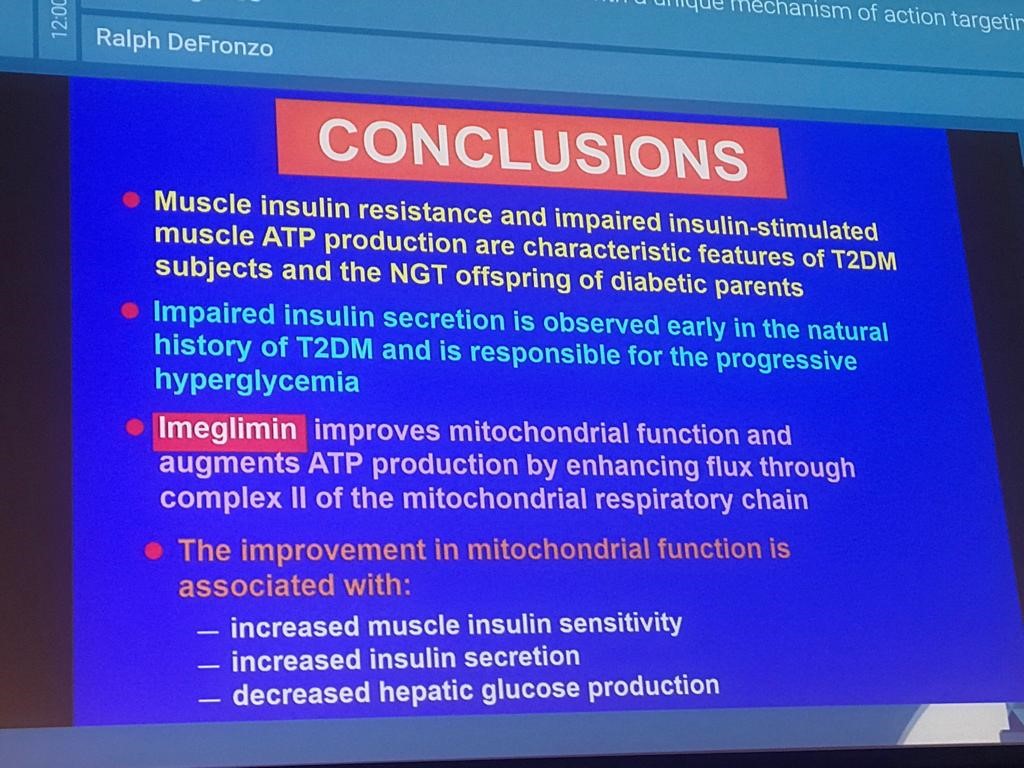
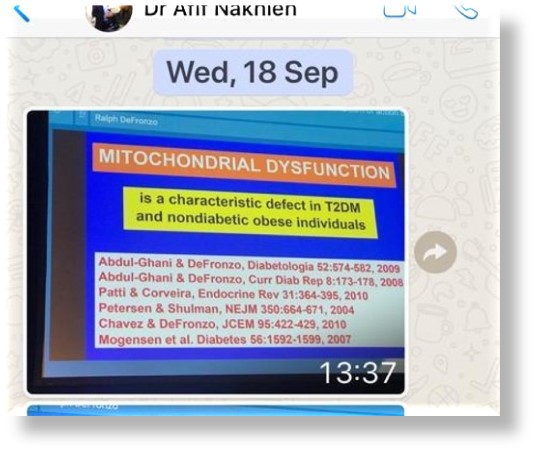
At the European Association for the Study of Diabetes conference in 2019, a colleague sent me a photo (attached) of a slide presented by that same San Antonio researcher, describing a novel drug that treats mitochondrial dysfunction and achieves:
Restoration of energy production
Lowering of high blood sugar
Improvement of insulin action
 Figures-
This confirmed what I had suspected—he had been working on a closely related idea, developing a treatment with a new drug produced by a Japanese company.
Years passed, and my conviction grew, informed by emerging scientific literature and by successful outcomes in several patients whose energy production defects I addressed. The "idea" transformed into a "hypothesis" I apply daily—and I was the first to apply it to myself, working to remove mitochondrial impediments, correct damage, and support mitochondrial structure.
A New Paradigm: the Logic of Survival vs. the Medical Model
A conviction took root in my mind: the prevailing medical model overlooks the "logic" of the body in managing energy economics.
Our survival over eons of evolution did not happen by accident—it occurred because the body designed a complex, intricate network for metabolizing fuel, rather than a single highway. A single highway would have rendered us vulnerable to extinction by a single mutation, whereas the complex network of alternative pathways ensures our continuity despite countless mutations.
This metabolic network extends beyond the boundaries of our organs. We have known for some time that fatty liver disease is associated with alterations in the gut microbiome (the so-called "second brain"), and that correcting the microbiome can reverse fatty liver.
Alzheimer's disease, sometimes referred to as type 3 diabetes, links brain degeneration to metabolic dysfunction and impaired energy production. More recent research in mice suggests that cells in the hypothalamus can trigger type 2 diabetes in the complete absence of its usual prerequisites: no insulin resistance, no obesity (Ref-2).
Mitochondria: More Than a Power Plant
Evolutionary biologists believe that mitochondria originated as primitive bacteria that merged with a primitive cell in an aquatic environment. This symbiotic merger gave the cell 18 times more energy than the older fermentation process, enabling life to emerge from water onto land and to evolve.
But the major surprise is that mitochondria are not merely power generators—they are an integrated, far-reaching system.
They can:
· Move from one cell to another.
· Exchange information between tissues via molecules they release or by traveling intact through the bloodstream.
· Read stress and damage within the cell and, based on that reading, either instruct the cell to continue and repair or program it for programmed cell death (apoptosis) to protect the larger entity.
The Third Brain: A Proposed Classification
If the defining characteristics of a "brain" include (receiving stimuli, making decisions, issuing effectors), then mitochondria deserve to be classified—and this is my proposal, introduced here for the first time—as the "Third Brain," for the reasons outlined above:
1. They receive signals from inside and outside the cell.
2. They read levels of stress and damage.
3. They make fateful decisions: either to continue and repair, or to initiate programmed death (apoptosis).
Thus, the foundation of life rests on three brains:
· The cranial brain (the familiar one)
· The enteric brain (the gut microbiome)
· The cellular brain (the mitochondria)
Remarkably, the second and third brains come to us from the mother! The microbiome is acquired during passage through the birth canal (absent in cesarean deliveries), and mitochondria originate exclusively from the egg.
This affirms that the female is the fundamental guarantor of life—not only by nourishing the fetus through the umbilical cord and breastfeeding the infant, but by bestowing upon us her metabolic gifts—a perspective that stands in stark contrast to certain prevailing cultural notions.
This is a classification I offer for discussion, hoping it adds a deeper dimension to our understanding of metabolic integration.
Muscle: Crossroads of Destiny and Indicator of Survival
The perspective I present here aligns with a broader view in Modern Systems Biology and Evolutionary Biology, which increasingly conceptualize living organisms as energy-processing systems designed for two overarching goals: survival and reproduction.
This brings us back to our conceptual framework
Creature = system organization for growth and reproduction
Living = capacity for energy generation
Within this framework, after exploring the three brains and the organs that serve our ultimate purpose—securing fuel and converting it into energy—a fundamental question remains:
What is the organ that translates this entire harmony into the actual capacity for survival, and that can serve as a measurable indicator of the health of the entire system?
The answer is muscle
The role of the locomotor system (skeleton and muscles) is not limited to transporting the digestive tract toward food sources—it extends to a far deeper function.
Muscle is now recognized as a true endocrine organ. It secretes signaling molecules—myokines—through which it communicates with the liver to release sugar, with the brain to regulate appetite, and with adipose tissue to manage energy stores.
It is a crossroad interface that receives survival signals, translates them into action, and in turn sends signals that inform the rest of the system about both resource availability and the effort expended.
Context Determines Meaning: Rest as Prosperity? Inactivity as a Harbinger of Decline?
Here lies the nuanced distinction that reveals the brilliance of biological design. The state of muscle carries two opposing meanings, determined by context:
· Rest after a meal (state of satiety): a sign of flourishing and well-being. The muscle, having performed its role in transporting the digestive tract toward food, now relaxes while the digestive tract digests, mitochondria produce energy, and storage systems stockpile. It is the "rest of the victor" who has secured sustenance.
· Inactivity in a state of hunger (state of deficiency): the opposite signal. When the environment lacks food and stores are depleted, any muscular inactivity becomes an ominous warning. It is an announcement of the organism's inability to move, of the failure of the executive arm of survival. It is the beginning of the path toward sarcopenia.
The Evolutionary Equation: Muscle as an Indicator of Biological Resilience
From an evolutionary and teleological perspective, muscular inactivity can be read as a signal of the organism's declining capacity to:
· Explore its environment
· Obtain nutritional resources
· Respond to threats
Consequently, declining muscle function cannot be considered merely a side effect of aging—it is a systemic indicator of reduced organismal resilience and approaching biological frailty.
Clinical Evidence: Grip Strength & Walking Speed
The evolutionary perspective I have outlined finds remarkable confirmation in clinical medicine literature. Among the diverse indicators proposed for predicting longevity, two stand out as among the strongest and most reliable:
Grip strength — "the capacity to struggle for & secure food".
Walking speed — "the capacity to be first reaching food, then leaving fast to avoid stealing it".
These two simple measures, obtainable with basic tools in just minutes, objectively reveal the organism's capacity for survival more powerfully than thousands of complex laboratory tests.
Why?
Because they directly reflect the integrity of the "executive arm of survival"—muscle—and its ability to translate available energy into tangible action in the physical world.
Thus, the circle is complete:
From the three brains that govern the decision to survive, to the muscle that executes that decision and declares its success or failure depending on context, to the measurable indicators that place in our hands a tool to predict who will live long and who is moving toward frailty.
Muscle is the mirror that reflects whether we remain living beings in the full sense of the word, or whether we have begun the gradual withdrawal from the equation of life.
Conclusion: Who Are We, Really?
From a purely metabolic perspective, our bodies can be understood as vehicles designed to serve a supreme purpose: ensuring fuel intake and its safe conversion into energy.
In this integrated system:
· The gastrointestinal tract is the core, the central hub for importing fuel.
· The skeletal system and muscles are the locomotion mechanism that transports this hub toward food sources.
· The heart and blood vessels are the transportation network that delivers fuel to all cells.
· The liver and kidneys are waste management and recycling.
· The immune system is the internal security force, safeguarding this system from internal breaches (such as cancer cells or opportunistic microbes) and external threats (predatory microorganisms), and performing precise cleanup of waste generated by vital processes.
· The eyes are the first line of defense and the direct environmental sensors, detecting immediate obstacles and dangers in the surroundings (falls, burns, drowning).
· The cranial brain undertakes the most complex task: receiving data from the eyes and other senses, analyzing patterns, anticipating risks before they occur, calculating probabilities, and making fateful decisions to avoid them. It is the "central computer" of survival.
Every organ and every system in this body, including the brain itself, functions in astonishing harmony to serve the supreme goal: the continuous flow of energy and the sustainability of life.
Invitation to Dialogue
In this article, I have attempted to present a novel perspective, proposing a new classification: recognizing mitochondria as the "Third Brain", alongside the cranial brain and the enteric brain, and considering the digestive tract as the "primary" system for life.
This classification is not yet established in medical jargon, but I see in it a framework that explains the interrelationship between energy, cellular decision-making, and survival. I also present muscle as an existential indicator of the health of this entire system.
I welcome a discussion with readers:
1. Do you find this a meaningful contribution?
2. Is it scientifically sound?
3. Or is it merely a set of literary metaphors with no real value?
Your feedback and engagement are what will enrich this idea and test its validity.
References